

 A Minnesota PBS Initiative
A Minnesota PBS Initiative
“Ma’am, you really made history, today.” The bashful young corpsman spoke softly as he passed the foot of my army cot. He wasn’t the only one trying to stifle his amusement.
“Nobody’s ever done what you did, before!”
“Just wait till the general comes and pins a Purple Heart on you!” This came from a patient propped up in his bed across the aisle from my feet.
“You’re kidding,” I protested. “I don’t get a Purple Heart for this, do I?”
“Well, are you sure there wasn’t some artillery going off when you fell? Then you would have been injured under fire!”
My first night as a hospital patient, rather than as a nurse on duty, I got little sleep. The booming noises in the distance must not have been worth worrying about, since the night shift staff seemed unruffled.
How could this have happened? The question I kept asking myself didn’t seem to have an answer. I would have to write a letter home, telling my family that I was a casualty, even before my feet touched the ground in Vietnam. Oh, yes. To top it off, it was April first, April Fools’ Day. And, that’s no joke.
The long flight over the Pacific to Vietnam could have been a novel in itself. But, that’s material for another story!
When we finally landed at Bien Hoa, our ankles were swollen and legs a bit shakey. Loading my arms with my carry-ons, my typewriter included, I followed the rest of the Army hospital personnel down the long aisle to exit at the front of the plane. This was it. I was here in the combat zone.
Beyond the door a bright overcast day and the heat greeted me. Back home we exited planes directly into a terminal walkway. Here, an outside stairway yawned in my face.
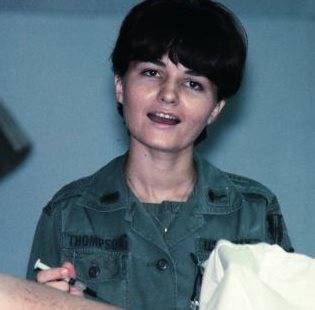
Edy on duty, Ward 1, 93rd Evac Hospital RVN.
On the second step from the top, it happened. With both hands full, I didn’t have a way to grab the railing. My ankle turned, suddenly throwing me down the stairs.
“Where is everybody?” flashed through my head, as I saw no hope of anyone breaking my fall. I slid to a stop near the bottom, right behind a couple doctors in their khaki uniforms. Both did an immediate on the spot assessment. “Does this hurt?” one asked as he tried to straighten my right ankle. “Ooh, yes!” I squealed, as the pain shot up my leg.
It was the same ankle I had once sprained in an auto accident. That time, the ankle swelled like a balloon, but the x-rays were negative. Since the ankle looked nowhere near as bad, this time, I figured I hadn’t hurt it too much. But, being with all those medical personnel, I ended up in a wheelchair, while the rest of the 95th Evac Hospital got into formation on the tarmac.
An Air Force doctor wearing a jumpsuit entered the room at the nearby clinic, trying to keep from smiling. “I’m afraid it’s broken,” he said, x-ray in hand.
“You’re kidding! What do I do now?” I said aloud. Inside my head, I carried on another conversation: God, didn’t You want me here, after all? Did you let me get this far, only to send me home, again?
The doctor from the plane accompanied me in the back of a rickety box ambulance, like ones I’d seen on old TV war movies. The two of us sat in back, across from a moaning patient on a litter. Outside, we raised a cloud of dust as we bounced over crowded streets that reminded me of Tijuana. We bypassed the 90th Replacement and went straight to the nearest Army medical facility.
The dusty, green-painted waiting room at the 93rd Evac already had enough real soldier patients, with bloody bandages and dirty faces furrowed by streaks of sweat. How could I have made more work for the hospital, when I only came to help!
A cheerful, redheaded Army nurse in jungle fatigues and combat boots greeted me and wheeled me off to see the orthopod, Captain Michael.
A beefy man with curly black hair, he entered the exam room with an amused chuckle, “Well, how would you like to go to Japan?”
“But, I just got here!” I wailed in despair, “can’t I stay?”
“Oh, we’ll cast your leg, and put you in the hospital, for now. You will have a profile, of course, ‘no prolonged standing, running, or jumping.’”
And, he exited laughing.
Postscript:
My first night as a hospital patient, rather than as a nurse on duty, I got little sleep. The booming noises in the distance must not have been worth worrying about, since the night shift staff, visible in the light from the nurses' station seemed unruffled. Still, it was a night to remember!
Later, I would ask someone how to protect our patients in body casts, should we have incoming artillery. The response: "They're some of the first ones getting themselves under the bed!" Otherwise, those too critical, or unconscious, would have a mattress thrown over to cover them. In some cases, I heard, a nurse lacking anything else had covered a helpless patient with her own body.
My cast served as another humorous ice-breaker. When new casualties arrived, another patient would tell the newcomer, "Ask that lieutenant how she broke her ankle!"
Daylight brought a string of visitors. Besides the chief nurse (I expected a scolding), who seemed to be having a hard time keeping a straight face as she told me not to worry, gave me a sigh of relief, instead. She told me I not only had to get used to the tropical climate, I would have a walking cast adjustment as well.
A variety of young G.I.s must have heard about my situation. More than one stopped to see who I was, and sat down to tell me some of their stories. The "Dear John" letters, and other heart breaking accounts of little children, one who was told to bring the G.I. something and he'd give him chocolate. Such awful split-second decisions these young men had to make!
Since I'd missed processing through the 90th Replacement center, I had to get my U.S. cash exchanged for MPCs (military certificates that looked more like Monopoly money). Although we brought along our white uniforms, we would be wearing jungle fatigues, here. Other items needing to be checked off the list for new arrivals in country had to be accomplished through intermediaries.
After a week in the hospital, I got my walking cast. When I reported for duty (they kept me at the 93rd, and I saw no more of my colleagues from the 95th that continued on to the new site up country), I found myself assigned, appropriately, to the orthopedic ward with a bunch of other casted limbs.
My cast served as another humorous ice-breaker. When new casualties arrived, another patient would tell the newcomer, "Ask that lieutenant how she broke her ankle!" The Vietnamese young women who worked on our ward initially asked as well, "V.C. do that?"
I guess I could say I felt right at home, right from the start! I had such a warm welcome, and the upbeat camaraderie among all I encountered surprised me. This wasn't at all what I had anticipated finding in the combat zone.
When I went on R&R, another nurse enroute with us must have overheard me telling someone about my "grand entrance." She laughed: "YOU were the one! I bet 200 letters went home that night, telling what happened."
Submitted From: Minneapolis, MN

Primary Location During Vietnam: Long Binh Post, Vietnam 
Story Subject: Military Service
Military Branch: U.S. Army
Veteran Organization: VVA Life Member
Unit: 93rd Evacuation Hospital
Specialty: Army Nurse Corps USAR
Story Themes: First Impressions, Humor, Levity, Medical Personnel, Physical Wounds, Relationships, Religion